Concrete pressure
Calculates the design compressive capacity NRd for concrete cross-sections according to NS-EN 1992-1-1. Checks whether the axial load at ultimate limit state is within capacity.
Also supports calculation of reduced compressive strength at a given concrete age in days.
Typical use: Checking concrete columns and compression-loaded cross-sections.
Key formulas
Design compressive strength
Characteristic cylinder strength (MPa)
Long-term factor (= 0.85)
Partial factor for concrete (= 1.5)
Compressive capacity
Cross-sectional area (mm²)
Design compressive strength (MPa)
Design compressive capacity (kN)
Inputs
- Concrete grade (B25–B90) or custom fck
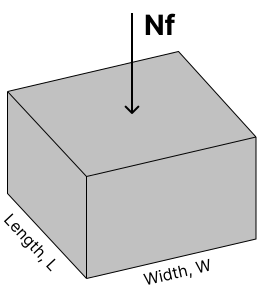
- Cross-section: rectangular, circular or custom area
- Design axial force, Nf
- Concrete age, t (optional – for reduced curing time)
Outputs
- Design compressive strength, fcd
- Design capacity, NRd
- Utilization, Nf / NRd
- Reduced fcd(t) at given age (if enabled)
Assumptions
- Axial force only – no bending moment or eccentricity
- No buckling check (slenderness not included)
- Plain concrete cross-section, no reinforcement
Video coming soon.