Fillet weld
The program calculates fillet weld capacity according to clause 4.5.3.2 (directional method) in NS-EN 1993-1-8:2005+NA:2009.
Typical use case: Capacity check of fillet weld connections with combined shear force, normal force and moment.
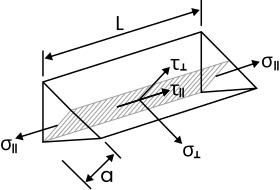
Key formulas
Resultant stress
Normal stress perpendicular to the weld throat
Shear stress perpendicular to the weld longitudinal axis
Shear stress parallel to the weld longitudinal axis
Design capacity
Nominal tensile strength
Correlation factor
Partial factor for welded connections
Inputs
- Throat thickness, a (mm)
- Weld length, leff (mm) and number of welds, n
- Shear force, Vf (kN)
- Normal force, Nf (kN) and moment, Mf (kNm)
Outputs
- Resultant stress, σres (N/mm²)
- Design capacity, σdim (N/mm²)
- Utilization (%)
- Normal stress condition, σ⊥ ≤ 0.9 · fu / γM2
Assumptions
- Directional method – 4.5.3.2 in NS-EN 1993-1-8:2005+NA:2009
- Rectangular weld cross-section with combined loading (V, N, M)
- All welds in the group are assumed identical
Video coming soon.